
Labour Law Compliance Audit Under New Labour Code 2025
The Indian labour landscape has transformed dramatically with the introduction of the New Labour Codes in 2025. For business owners across India whether you’re running a small manufacturing unit, a retail chain, or a service company understanding labour law compliance is no longer optional. It’s a business necessity that can protect you from hefty penalties, legal troubles, and operational disruptions.
A Labour Law Compliance Audit is your business’s health checkup for legal compliance. Just as you wouldn’t skip a medical checkup, you shouldn’t skip a compliance audit. Let’s break down what this means in simple terms and why it matters for your business.
What is a Labour Law Compliance Audit?
Think of a Labour Law Compliance Audit as a detailed examination of how your business treats its employees from a legal perspective. It’s a systematic review that checks whether you’re following all the employment laws that apply to your business.
The audit examines everything from how you pay salaries to how you maintain employee records, from workplace safety measures to statutory benefits like Provident Fund (PF) and Employee State Insurance (ESI). It identifies gaps between what you’re currently doing and what the law requires you to do.
In simple terms: It’s a comprehensive review that tells you where you stand legally and what you need to fix to avoid trouble with government authorities.
Understanding the New Labour Codes 2025
Before diving into audits, let’s understand what changed with the New Labour Codes.
India previously had 29 different central labour laws each with its own rules, paperwork, and compliance requirements. It was complicated, confusing, and difficult for businesses to navigate. The government consolidated these 29 laws into just 4 comprehensive codes:
- The Code on Wages, 2019 This code deals with how you pay your employees minimum wages, salary structures, payment timelines, and deductions.
- The Industrial Relations Code, 2020 This covers your relationship with employees hiring, firing, trade unions, layoffs, and dispute resolution.
- The Code on Social Security, 2020 This handles employee benefits PF, ESI, gratuity, maternity benefits, and now extends to gig workers and platform workers.
- The Occupational Safety, Health and Working Conditions Code, 2020 This ensures workplace safety working hours, leave policies, health measures, and working conditions.
Why Your Business Needs a Compliance Audit Now
Many business owners ask: “We’ve been running successfully for years without audits. Why do we need one now?”
Here’s why:
- The Rules Have Changed Fundamentally
What was compliant under old laws might not be compliant under new codes. For example, if you’re paying employees with 30% basic salary and 70% allowances, you’re likely non-compliant under the new wage code. You might not even realize you’re violating the law until an inspection happens.
Real Example: A Mumbai-based IT company with 80 employees thought they were fully compliant. A compliance audit revealed they needed to restructure salaries for 45 employees, update their PF calculations, and revise their leave policy. The cost of fixing these issues proactively was ₹2.5 lakhs. Had they been caught during a government inspection, penalties would have exceeded ₹10 lakhs, plus potential business disruption.
- Digital Trail Makes Detection Easier
The new codes emphasize digital record-keeping and online filing. Government systems can now automatically detect inconsistencies like PF contributions not matching reported salaries, or ESI coverage gaps. What could be hidden in paper files before is now transparent in digital systems.
- Expansion of Your Business Triggers Compliance
Planning to hire more staff? Open a new branch? Apply for bank loans? Get government contracts? All these require proof of labour law compliance. An audit ensures you’re ready when opportunities arise.
- Employee Awareness Is Increasing
Today’s employees know their rights. Social media and online forums mean compliance issues can become public quickly, damaging your reputation. A compliance audit prevents situations where employees discover they’re not getting entitled benefits.
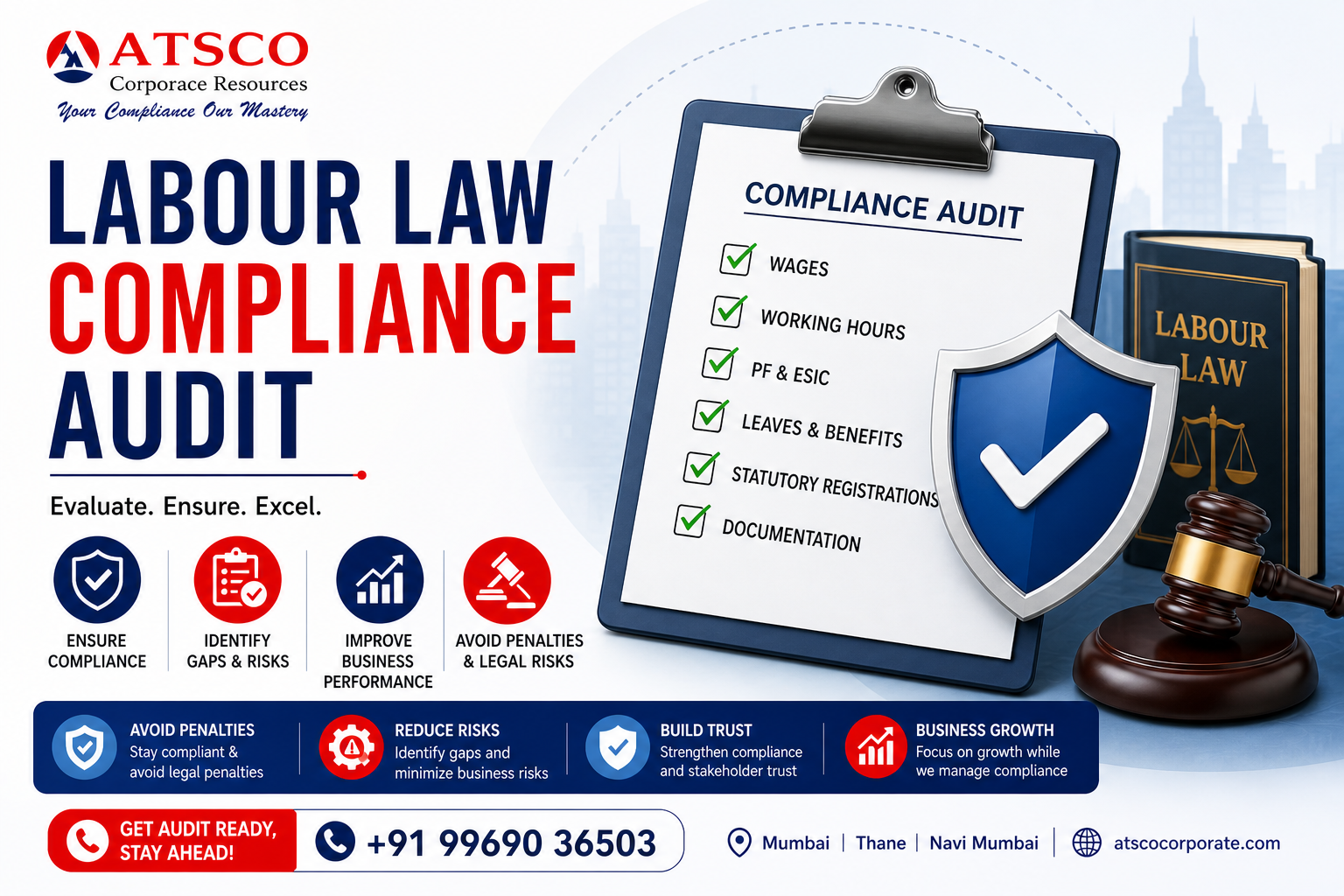
What Does a Labour Law Compliance Audit Cover?
A comprehensive audit examines multiple aspects of your employment practices. Here’s what auditors check:
1. Wage and Salary Compliance
What’s Checked:
- Is your wage structure compliant with the 50% basic salary rule?
- Are you paying minimum wages as per state schedules?
- Do salary slips show all components correctly?
- Are deductions (PF, ESI, TDS, Professional Tax) calculated accurately?
- Are salaries credited on time (before the 7th of each month)?
- Are wage registers maintained properly?
2. Statutory Compliance (PF, ESI, Professional Tax)
What’s Checked:
- Is your establishment registered with EPFO if you have 20+ employees (10+ for certain sectors)?
- Are all eligible employees enrolled in PF?
- Are PF contributions calculated correctly (12% of basic for employee and employer)?
- Is ESI applicable (establishments with 10+ employees in notified areas)?
- Are ESI contributions accurate (0.75% employee, 3.25% employer)?
- Is Professional Tax deducted and deposited correctly?
- Are all monthly returns filed on time?
- Are annual returns submitted?
3. Attendance, Leave, and Working Hours
What’s Checked:
- Are attendance registers maintained (digital or physical)?
- Are leave records accurate and accessible?
- Does your leave policy comply with the Occupational Safety Code?
- Are weekly offs provided (one day per week mandatory)?
- Are working hours within legal limits (48 hours per week, 9 hours per day)?
- Is overtime calculated and paid correctly?
Are shift workers given adequate rest periods?
4. Workplace Safety and Health
What’s Checked:
- Do you have required safety equipment and first aid facilities?
- Are fire safety measures in place and documented?
- For factories: Are dangerous machinery permissions obtained?
- Are health and safety committees constituted (required for 250+ workers)?
- Are periodic safety inspections conducted?
- Are accident registers maintained?
- Is workplace lighting, ventilation, and sanitation adequate?
5. Employment Documentation
What’s Checked:
- Are appointment letters issued to all employees?
- Do employment contracts clearly state terms and conditions?
- Are employee records maintained with complete details?
- Are Form 11 (EPF nomination) and Form 1 (ESI declaration) collected?
- Are exit formalities documented properly (resignation letters, full and final settlements)?
- Are service records maintained for statutory inspections?
6. Contractor and Third-Party Compliance
What’s Checked:
- Are contractors registered under applicable laws?
- Do you have valid contracts with labor contractors?
- Are contractor employees covered under PF/ESI?
- Are contractor licenses verified and valid?
- Is there clarity on who bears statutory responsibility?
7. Special Provisions (Women, Young Persons, Persons with Disabilities)
What’s Checked:
- Are provisions for women employees met (separate toilets, crèche if 50+ women)?
- Are working hour restrictions for women followed (night shifts require permission)?
- Are young persons (15-18 years) employed legally with certificates?
- Are provisions for persons with disabilities implemented?
- Is the maternity benefit being provided as per law?
8. Display Requirements and Notices
What’s Checked:
- Are statutory notices displayed prominently (working hours, leave rules, holidays)?
- Is the certificate of registration displayed?
- Are prescribed abstracts of the codes displayed?
- Are inspection books maintained and accessible?
The Audit Process - What to Expect
Understanding the audit process removes anxiety about what will happen. Here’s how a professional labour law compliance audit typically works:
Step 1: Initial Assessment and Planning
The auditor meets with you to understand your business:
- Number of employees and their categories
- Nature of business and industry sector
- Locations and number of establishments
- Current understanding of compliance
- Previous inspection history, if any
Based on this, they create an audit plan customized to your business.
Step 2: Document Collection and Review
You’ll need to provide various documents:
- Employee master list with salary details
- PF and ESI registration certificates
- Salary registers and pay slips (sample months)
- Attendance and leave records
- Statutory return copies (PF, ESI, PT)
- Appointment letters and employment contracts
- Safety inspection records
- Workplace facility documentation
The auditor reviews these against legal requirements.
Step 3: Physical Inspection
For factories and establishments with physical operations, the auditor conducts:
- Workplace walkthrough checking safety measures
- Employee facility inspection (toilets, drinking water, first aid)
- Verification of displayed notices and abstracts
- Review of accident and safety equipment
- Assessment of working conditions
Step 4: Employee Interviews (if required)
Sometimes, auditors conduct brief, confidential interviews with employees to verify:
- Whether they receive salary on time
- Understanding of their benefits and entitlements
- Knowledge of leave policies
- Awareness of safety measures
- Any grievances or compliance concerns
This isn’t about finding fault it’s about getting a complete compliance picture.
Step 5: Compliance Gap Analysis
The auditor compares findings against legal requirements and identifies:
- Critical gaps: Serious violations requiring immediate action
- Moderate gaps: Issues needing attention within 1-3 months
- Minor gaps: Areas for improvement without immediate legal risk
Step 6: Audit Report and Recommendations
You receive a comprehensive report containing:
- Executive summary of compliance status
- Detailed findings with specific law references
- Risk assessment for each gap
- Prioritized action plan with timelines
- Cost implications of fixing issues
- Recommendations for ongoing compliance
Step 7: Remediation Support
Professional audit services often include:
- Guidance on fixing identified issues
- Sample documents and templates
- Support in registrations or filings
- Employee communication assistance
- Follow-up reviews to ensure corrections
Google Reviews by Clients


It has experienced & dedecated staff round the clock to give you prompt service without any hurdles.
*Best services*


A All
T Together
S Support
C Councilling for PF, ESIC, Employee and Company
O Office of sorting out problem of all
Come and share your problems as your compliments our Mastery
Common Compliance Gaps Found in Audits
Based on hundreds of audits across businesses, here are the most common issues discovered:
- Wage Structure Non-Compliance (Found in 70% of audits)
Most businesses haven’t restructured salaries to meet the 50% basic salary requirement. This creates a cascading effect incorrect PF contributions, wrong gratuity provisioning, and non-compliant salary structures.
Fix: Restructure salaries ensuring basic is at least 50%, communicate changes to employees explaining the long-term benefits (higher PF accumulation), and adjust all statutory calculations.
- Missing or Delayed Statutory Registrations (Found in 55% of audits)
Businesses cross the threshold for PF (20 employees) or ESI (10 employees) but delay registration for months, sometimes years. During this period, they’re operating illegally and accumulating liability.
Fix: Immediate registration, back-calculate all contributions from the date of applicability, deposit arrears, and file returns. While this involves back-payment, it’s far cheaper than discovery during inspection with penalties.
- Inadequate Record-Keeping (Found in 65% of audits)
Wage registers incomplete, attendance records missing, no proper employee files, safety inspection records absent. When inspections happen, missing records are treated as violations even if you were actually compliant.
Fix: Implement systematic record-keeping, use digital HR systems for automation, assign clear responsibility for maintenance, and conduct periodic internal reviews.
- Contractor Compliance Gaps (Found in 80% of audits using contractors)
Principal employers assume contractors handle all compliance, but legally both share responsibility. Often contractors aren’t properly registered, their employees lack PF/ESI coverage, or contracts don’t clearly define responsibilities.
Fix: Verify contractor registrations and licenses, ensure written contracts defining compliance responsibilities, periodically audit contractor statutory payments, and maintain contractor compliance files.
- Safety and Health Deficiencies (Found in 60% of manufacturing/factory audits)
Missing first aid facilities, no fire safety equipment, inadequate sanitation, poor lighting or ventilation, and absence of safety committees despite being required.
Fix: Conduct safety audit, purchase required equipment, establish safety committees, train employees on safety procedures, and maintain inspection and accident records.
Cost of Non-Compliance vs. Cost of Compliance
Many business owners worry about the cost of conducting audits and fixing issues. Let’s look at the reality:
Cost of Professional Compliance Audit:
- For 50-employee business: ₹25,000-₹40,000
- For 100-employee business: ₹40,000-₹70,000
- For 200+ employee business: ₹70,000-₹1,50,000
This is a one-time assessment cost.
How Often Should You Conduct Compliance Audits?
Annual Audits: Every business should conduct a comprehensive compliance audit at least once annually. This is especially important in the years immediately following the new Labour Codes’ implementation.
Quarterly Reviews: Businesses with 100+ employees or those in high-risk sectors (manufacturing, construction, hazardous industries) should conduct quarterly compliance reviews.
Trigger-Based Audits: Conduct audits when:
- You cross employee count thresholds (10, 20, 50, 100, 250 employees)
- You’re expanding to new locations
- You’re applying for bank loans or government contracts
- Major HR policy changes are planned
- You’ve received any compliance notice or warning
- You’re undergoing mergers or acquisitions
- New Labour Code provisions are implemented
Business Disruption
- Operations stoppage: Inspectors can order operations to stop for serious safety violations
- License cancellation: Repeated violations can lead to business license cancellation
- Contract losses: Compliance certificates required for major contracts; non-compliance means lost business opportunities
Reputational Damage
- Employee dissatisfaction: Workers discovering they’re not getting entitled benefits creates mistrust
- Social media: Compliance issues can go viral, damaging brand reputation
- Investor concerns: For companies seeking funding, compliance issues are red flags
- Vendor relationships: Major corporations now audit their vendors’ labour compliance
Compliance as Competitive Advantage
Labour law compliance under the New Labour Codes 2025 is no longer just about avoiding penalties it’s about building a sustainable, ethically sound business that attracts talent, satisfies investors, and operates without constant legal anxiety.
A Labour Law Compliance Audit is your roadmap to this compliance. It identifies where you stand, what needs fixing, and how to get there. The cost is minimal compared to the protection it provides.
In today’s environment where labour law enforcement is becoming stricter, digital systems make violations easier to detect, and employee awareness is increasing, compliance isn’t optional it’s essential for business survival and growth.
Whether you’re running a 10-employee startup or a 500-employee manufacturing unit, a professional compliance audit is one of the smartest investments you can make in your business’s future.
Get Your Labour Law Compliance Audit with ATSCO Corporate Resources
Don’t wait for a government inspection to discover compliance gaps. ATSCO Corporate Resources specializes in comprehensive Labour Law Compliance Audits under the New Labour Code 2025, helping businesses across industries achieve complete compliance with confidence.
Our Compliance Audit Services Include:
- Comprehensive Multi-Code Audit: Complete assessment covering all four Labour Codes
- Wage Structure Analysis: Review and recommendations for new wage structure requirements
- Statutory Compliance Check: PF, ESI, Professional Tax, and all mandatory registrations
- Documentation Review: Assessment of all required records and registers
- Safety and Health Audit: Workplace safety compliance under OSH Code
- Contractor Compliance: Third-party and contractor compliance verification
- Detailed Report: Comprehensive findings with specific law references and risk assessment
- Prioritized Action Plan: Step-by-step remediation roadmap with timelines
- Implementation Support: Guidance and templates for fixing identified issues
- Follow-up Review: Verification audit to ensure all gaps are addressed
Why Choose ATSCO Corporate Resources?
Experience and Expertise
With 18 years of experience, ATSCO Corporate Resources is a trusted labour law consultancy firm, serving 50+ corporates across diverse industries
Comprehensive Services
Providing end-to-end functions of payroll services, including time and attendance management and leave processing
Skilled Team
Emphasize the expertise of the team in handling complex payroll issues