
Menu
Impact on Contract Labour Under New Labour Code 2025
Contract labour is the backbone of many Indian industries—from manufacturing units to IT companies, construction sites to hospitality businesses. The New Labour Code 2025 has significantly changed how contract workers must be managed, protected, and compensated. If your business uses contract labour, understanding these changes isn’t optional—it’s essential for legal compliance and avoiding severe penalties. Impact on Contract Worker under New Labour Code 2025 explained

What is Contract Labour?
Contract labour refers to workers employed through a contractor (third party) rather than directly by the principal employer. For example, if you run a manufacturing unit in Thane and hire a contractor who supplies 50 workers for your production line, those workers are contract labour.
Key parties involved:
- Principal Employer: The business/factory owner (you)
- Contractor: The person/agency supplying workers
- Contract Workers: The actual workers performing the job
Under the new codes, all three parties have specific responsibilities and legal obligations.
Major Changes Under New Labour Code 2025
- Unified Definition and Coverage
Previously, contract labour was regulated under the Contract Labour (Regulation and Abolition) Act, 1970. Now it’s covered under Chapter VIII of the Occupational Safety, Health and Working Conditions Code, 2020.
Key Change: The threshold for applicability has been standardized. If you employ 20 or more contract workers (directly or through contractors), the code applies. Some states may have lower thresholds—check your state rules.
What this means: Smaller establishments that previously escaped regulation may now be covered. A Ghatkopar warehouse employing 25 contract workers must now comply fully.
- Mandatory Contractor Registration and Licensing
Previous System: Contractors needed licenses, but enforcement was weak. Many operated without proper registration.
New Code Requirement:
- Every contractor must obtain a license from the appropriate authority
- Principal employers cannot engage unlicensed contractors
- Licenses must be renewed periodically
- Engaging unlicensed contractors makes the principal employer liable for all violations
Penalty: Principal employers engaging unlicensed contractors face fines up to ₹50,000 and potential imprisonment up to three months.
Real Example: A Vikhroli manufacturing unit hired a contractor supplying 30 workers. During inspection, authorities found the contractor had no valid license. The factory owner faced penalties and was ordered to directly absorb all workers with full benefits—an unexpected cost of ₹15 lakhs annually.
Action Required: Before engaging any contractor, verify:
- Valid contractor license (check expiry date)
- Registration certificate
- Previous compliance record
- PF/ESI registrations
- Equal Wages and Benefits
Biggest Change: Contract workers performing the same or similar work as regular employees must receive equal wages and benefits.
Previous Practice: Contract workers often received 30-40% lower wages than permanent employees doing identical work. This created a two-tier workforce.
New Requirement:
- Same wage rates for same work
- Equal working hours and conditions
- Same welfare facilities (canteen, restrooms, drinking water)
- Equal safety equipment and training
Example: If your permanent machine operators earn ₹18,000 monthly, contract workers operating the same machines must also earn ₹18,000 for the same hours. You can’t pay them ₹12,000 just because they’re contractual.
Exception: Differences in wages are permissible only if there are genuine differences in:
- Skill levels required
- Experience needed
- Nature of work performed
- Qualifications demanded
Impact: This significantly increases labour costs for businesses heavily reliant on contract workers. A Thane logistics company employing 80 contract workers had to increase their wage bill by ₹4.5 lakhs monthly to comply with equal wage provisions.
- Statutory Benefits Coverage
Mandatory Coverage: All contract workers must be covered under:
- Provident Fund (PF): If the establishment employs 20+ workers (contract + permanent combined)
- ESI: If the establishment employs 10+ workers in notified areas
- Gratuity: Contract workers completing 5 years continuous service
- Bonus: Annual bonus as per Payment of Bonus Act
- Leave: Earned leave, sick leave, casual leave as per OSH Code
Shared Responsibility: Both principal employer and contractor are responsible for ensuring coverage.
Common Violation: A Mulund hotel employed 45 workers through three different contractors. None of the contractors enrolled workers in PF/ESI, assuming the principal employer wasn’t responsible. During inspection, the hotel was held liable for all unpaid contributions for three years—₹12.8 lakhs plus penalties.
Critical Point: You cannot escape statutory obligations by using contractors. If contractors don’t comply, YOU are liable.
- Welfare Facilities and Safety
Equal Facilities Mandate: Contract workers must receive the same welfare facilities as permanent employees:
- Canteen facilities (if 100+ workers employed)
- First aid facilities
- Restrooms and washing facilities
- Drinking water
- Creche (if 50+ women workers)
- Proper lighting and ventilation
Safety Equipment: Contract workers must receive:
- Personal protective equipment (PPE)
- Safety training before starting work
- Same safety protocols as permanent staff
- Coverage under accident insurance
Example: A chemical manufacturing unit in Bhandup provided safety equipment only to permanent workers. Contract workers handling the same chemicals received basic gear. After an accident involving a contract worker, inspection revealed this disparity. The company faced ₹2 lakh penalty plus compensation to the injured worker, and operations were temporarily halted until all workers received proper equipment.
- Written Contracts and Transparency
Mandatory Documentation:
Between Principal Employer and Contractor:
- Written contract specifying work scope, duration, number of workers
- Clear definition of responsibilities (who provides materials, supervision, safety equipment)
- Wage payment responsibility
- Statutory compliance responsibility
- Contract value and payment terms
Between Contractor and Workers:
- Written appointment letters
- Clear wage breakup
- Working hours and shift details
- Leave entitlements
- Notice period for termination
Wage Slips: Every contract worker must receive monthly wage slips showing:
- Gross wages earned
- Deductions (PF, ESI, PT, etc.)
- Net wages paid
- Number of days worked
Payment Timeline: Wages must be paid by the 7th of the following month, not delayed arbitrarily.
Inspection Requirement: These documents must be available for inspection at the workplace at all times.
- Prohibition of Contract Labour in Core Activities
Critical Provision: The new code empowers the government to prohibit contract labour in core/perennial activities of an establishment.
What are core activities?: Work that is:
- Essential to the main business
- Continuous (not seasonal or temporary)
- Integral to production or service delivery
Example:
- Manufacturing unit: Operating production machinery is core; canteen services are not
- Hospital: Nursing care is core; housekeeping is not
- IT company: Software development is core; security services are not
If contract labour is prohibited in your core activity: You must employ workers directly as permanent employees with full benefits.
Current Status: States are still defining which activities will face prohibition. However, this provision creates significant future risk for businesses planning long-term contract labour usage in core operations.
- Increased Inspection Powers
Inspection Officers under the new code have expanded powers:
- Inspect any workplace using contract labour without prior notice
- Check all registers, records, and documents
- Interview workers to verify compliance
- Issue improvement notices for violations
- Stop operations if serious safety violations are found
- File criminal complaints for serious breaches
Digital Integration: Inspections are now documented digitally and tracked centrally, making it harder to hide violations or negotiate unofficial settlements.
- Penalties and Consequences
Financial Penalties:
- Engaging unlicensed contractors: Up to ₹50,000
- Non-maintenance of registers: Up to ₹20,000
- Violation of working conditions: Up to ₹50,000
- Safety violations: Up to ₹2,00,000
- Repeated violations: Double penalties
Criminal Liability:
- Imprisonment from 3 months to 1 year for serious violations
- Directors and responsible officers can be held personally liable
Business Consequences:
- Operations can be stopped until compliance is achieved
- Contracts with government and major corporations require compliance certificates
- Bank loans scrutinize labour compliance
- Reputation damage affecting recruitment and business
Real Case: A construction contractor in Thane employed 120 workers without PF/ESI coverage, improper safety measures, and no valid license. Following a fatal accident, inspection revealed multiple violations. Result:
- ₹8.5 lakh penalties
- 6-month imprisonment for contractor (suspended pending appeal)
- ₹25 lakh compensation to victim’s family
- Project halt for 3 months causing ₹1.2 crore loss to principal employer
- Permanent damage to company reputation
Practical Impact on Different Industries
Manufacturing Sector
Impact: High. Manufacturing heavily uses contract labour for production, packaging, and material handling.
Action Required:
- Verify all contractor licenses and renew before expiry
- Ensure equal wages for contract and permanent workers doing same jobs
- Provide identical safety equipment and facilities
- Maintain detailed records of all contract workers
- Regular audits of contractor compliance
Cost Increase: 25-40% increase in contract labour costs due to equal wages and statutory benefits.
IT and Service Sector
Impact: Medium. IT companies use contractors mainly for support services (housekeeping, security, cafeteria, transport).
Action Required:
- Document that support services are non-core activities
- Ensure contractors provide statutory benefits to their workers
- Verify contractor compliance quarterly
- Maintain visitor records showing contractor worker entry/exit
- Provide same facilities (restrooms, cafeteria access) to contract workers
Cost Increase: 15-25% increase in outsourced service costs as contractors factor in compliance costs.
Construction and Real Estate
Impact: Very High. Construction is contract labour-intensive with multiple contractors and sub-contractors.
Action Required:
- Register each project site separately
- License verification for all contractors and sub-contractors
- Daily attendance records for all workers
- Safety training mandatory before workers enter site
- First aid facilities at every site
- Clear contracts defining responsibilities
Cost Increase: 30-50% increase in labour costs. Many developers are shifting to direct employment or mechanization to reduce dependence on contract labour.
Hospitality and Retail
Impact: High. Hotels, restaurants, and retail chains extensively use contract workers for housekeeping, security, and seasonal staff.
Action Required:
- Seasonal workers still need proper contracts and benefits
- Equal wages for contract and permanent workers in same roles
- Proper record-keeping across multiple outlets
- Centralized contractor compliance monitoring
Cost Increase: 20-35% increase in operational costs related to contract labour.
What principal employers must do now
Step 1: Audit Current Contract Labour Usage
Assess:
- How many contract workers you employ
- Who are your contractors (registered/licensed?)
- What work contract workers perform (core or non-core?)
- Current wage comparison (contract vs. permanent workers)
- Statutory coverage status (PF/ESI enrollment?)
- Documentation quality (contracts, registers, wage slips?)
Step 2: Verify Contractor Compliance
Check each contractor’s:
- Valid license (not expired)
- Registration certificate
- PF and ESI registration
- Previous compliance record
- Financial capability to pay wages and benefits
Red Flag: If contractors quote significantly lower rates than others, they’re likely cutting corners on compliance. Engaging them transfers liability to you.
Step 3: Restructure Contracts
Update all agreements to clearly specify:
- Contractor’s obligation to pay minimum/equal wages
- Responsibility for PF/ESI enrollment and payment
- Safety equipment provision
- Indemnity clauses for non-compliance
- Right to inspect contractor’s compliance documents
- Termination rights for compliance violations
Step 4: Equalize Wages and Benefits
Compare wages of contract vs. permanent workers in similar roles. If disparities exist:
- Negotiate with contractors to increase wages
- Accept higher contract costs
- Document justifications for any remaining differences (skill, experience, nature of work)
Step 5: Implement Monitoring Systems
Monthly monitoring:
- Verify contractor workers’ PF/ESI enrollment
- Check wage payment proofs
- Review attendance registers
- Inspect safety compliance
- Collect wage slip copies
Quarterly audits:
- Comprehensive contractor compliance review
- Documentation verification
- Worker interviews (confidential feedback)
- Identify and address gaps
Step 6: Provide Equal Facilities
Ensure contract workers access:
- Same restrooms, canteens, drinking water
- Same safety equipment and training
- Same working hour limits and rest periods
- Same grievance redressal mechanisms
Physical segregation (separate facilities for contract workers) violates equal treatment provisions.
Step 7: Maintain Comprehensive Records
Registers to maintain:
- Register of contractors (Form XIV)
- Register of contract workers (muster roll)
- Wage register showing individual worker payments
- Attendance register
- Overtime register (if applicable)
- Leave register
- Accident register
- Safety equipment issue register
Digital records are acceptable and recommended for easier inspection access.
Step 8: Plan for Prohibition Scenarios
If your state prohibits contract labour in your core activity:
- Assess which workers perform core functions
- Plan transition to direct employment
- Calculate financial impact
- Consider automation alternatives
- Develop hybrid models (direct for core, contract for non-core)
Benefits of Compliance
While compliance increases costs, it also brings benefits:
Reduced Legal Risk: No penalties, imprisonment threats, or operation disruptions.
Better Worker Productivity: Workers receiving fair wages and benefits are more motivated and productive.
Reputation Enhancement: Ethical labour practices improve brand image, attracting better clients and talented workers.
Contract Opportunities: Government contracts and major corporations increasingly require labour compliance certificates.
Reduced Turnover: Better-treated contract workers stay longer, reducing recruitment and training costs.
Operational Stability: No surprise inspection shutdowns or legal battles disrupting business.
Google Reviews by Clients

Dhawal Gadda
2 years ago
I highly recommend ATSCO for anyone looking for reliable, knowledgeable, and dedicated labour law services.

keshav korgaonkar
2 years ago
ATSCO is a professionally managed consultacy firm believe in employee's upgradation in their skill and knowledge.

Manjeet Bilthare
2 years ago
Good services especially for Labour Law Compliance. I will highly recommend ATSCO to others.

Sandip Jangle
2 years ago
ATSCO is genuine Company which had mastered & deals in day to day activity of Company's Legal compliance (Labour Laws)
It has experienced & dedecated staff round the clock to give you prompt service without any hurdles.
*Best services*

Rohan Margaj
2 years ago
Professionals,5 ⭐⭐⭐⭐⭐ for all the staff . Great co-ordination and support for any query related compliance and labour law, Customer gets the worth for the money he is spending to avail consultancy services..

Purav Shah
2 years ago
ATSCO
A All
T Together
S Support
C Councilling for PF, ESIC, Employee and Company
O Office of sorting out problem of all
Come and share your problems as your compliments our Mastery
Common Mistakes to Avoid
Mistake 1: “Using contractors means I’m not responsible for workers.”
Reality: You share responsibility. If contractors don’t comply, you’re liable.
Mistake 2: “We pay contractors well; what they pay workers is their business.”
Reality: You must verify workers receive statutory wages and benefits, regardless of what you pay contractors.
Mistake 3: “Contract workers don’t need the same facilities as permanent staff.”
Reality: Equal treatment is mandatory. Separate/inferior facilities for contract workers violate the code.
Mistake 4: “We’ll deal with compliance if we get inspected.”
Reality: Inspections are unannounced. When caught non-compliant, penalties and back-payments are far costlier than proactive compliance.
Mistake 5: “Small businesses don’t need to worry about these rules.”
Reality: If you employ 20+ workers (including contract workers), the code fully applies regardless of business size.
Future Outlook
The government is serious about contract labour protection. Expect:
Stricter Enforcement: More frequent inspections, especially in manufacturing and construction.
Digital Integration: Contractor licenses, worker registrations, and wage payments will be digitally tracked and cross-verified with PF/ESI databases.
State-Level Prohibitions: More states will prohibit contract labour in core activities, forcing businesses to shift to direct employment models.
Worker Awareness: Contract workers are increasingly aware of their rights through NGOs, unions, and social media. Violations will more likely be reported.
Compliance as Competitive Advantage: Companies with strong compliance records will win contracts and attract better talent.
The New Labour Code 2025 fundamentally changes contract labour management in India. The era of using contractors to avoid statutory obligations, pay lower wages, or reduce employee benefits is over. Contract workers now enjoy nearly equal protection and benefits as permanent employees.
For businesses, this means:
- Higher labour costs (25-40% increases common)
- Increased compliance responsibilities
- Greater documentation requirements
- Shared liability with contractors
- Significant penalties for violations
However, businesses that adapt proactively—verifying contractor compliance, equalizing wages and benefits, maintaining proper records, and treating all workers fairly—will navigate these changes successfully while building stronger, more sustainable operations.
The question isn’t whether to comply, but how to comply efficiently while maintaining business viability. Professional guidance from labour law consultants can help you restructure contract labour arrangements to balance legal compliance with operational needs.
Navigate Contract Labour Compliance with ATSCO Corporate Resources
Managing contract labour under New Labour Code 2025 is complex and risky. ATSCO Corporate Resources specializes in helping businesses achieve full compliance while optimizing costs and maintaining operational flexibility.
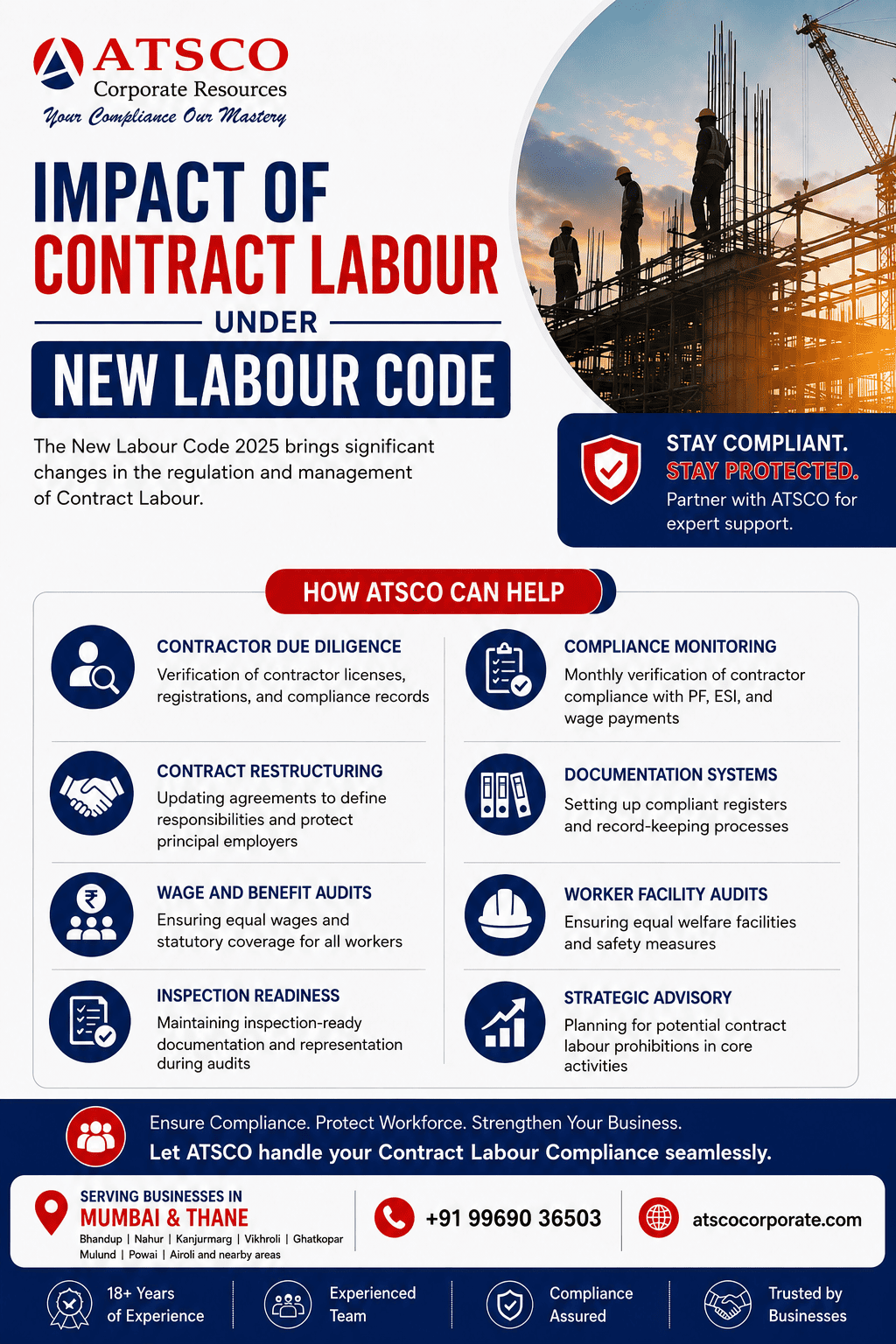
Our Contract Labour Compliance Services:
- Contractor Due Diligence: Verification of contractor licenses, registrations, and compliance records
- Contract Restructuring: Updating agreements to define responsibilities and protect principal employers
- Wage and Benefit Audits: Ensuring equal wages and statutory coverage for all workers
- Compliance Monitoring: Monthly verification of contractor compliance with PF, ESI, and wage payments
- Documentation Systems: Setting up compliant registers and record-keeping processes
- Worker Facility Audits: Ensuring equal welfare facilities and safety measures
- Inspection Readiness: Maintaining inspection-ready documentation and representation during audits
- Strategic Advisory: Planning for potential contract labour prohibitions in core activities
- Deep expertise in New Labour Code 2025 provisions
- Experience across manufacturing, construction, IT, hospitality, and retail sectors
- Practical solutions balancing compliance with business needs
- Proven track record helping Mumbai businesses manage contract labour compliance
- Ongoing support adapting to regulatory changes
Don’t let contract labour compliance become a legal and financial liability. Contact ATSCO Corporate Resources today for comprehensive contract labour management under New Labour Code 2025.
Protect your business. Ensure fair treatment for all workers. Operate with complete legal confidence. Call us now for expert contract labour compliance solutions.
Why Choose ATSCO Corporate Resources?
Experience and Expertise
With 18 years of experience, ATSCO Corporate Resources is a trusted labour law consultancy firm, serving 50+ corporates across diverse industries
Comprehensive Services
Providing end-to-end functions of payroll services, including time and attendance management and leave processing
Skilled Team
Emphasize the expertise of the team in handling complex payroll issues
Why Mumbai Businesses Choose ATSCO Corporate Resources
Protect your business. Ensure fair treatment for all workers. Operate with complete legal confidence. Call us now for expert contract labour compliance solutions.