
Common Documentation Mistakes made During POSH Inquiry
Documentation is where POSH investigations succeed or fail. An investigation might be perfectly conducted—fair to all parties, thorough in evidence collection, and appropriate in conclusions—but poor documentation can render even the strongest investigation legally vulnerable. Conversely, meticulous documentation can support findings even when investigation process was moderately conducted.
Yet, many Internal Complaints Committee (ICC) members, HR professionals, and organizations make preventable documentation errors during POSH inquiries. These mistakes don’t just create compliance issues; they undermine investigations, create legal liability, and demonstrate disregard for the seriousness of harassment allegations. Understanding these mistakes helps organizations across Mumbai—from BKC corporate offices to Andheri manufacturing units—conduct investigations that withstand legal scrutiny. In this blog we will discuss about Documentation mistakes during POSH inquiry
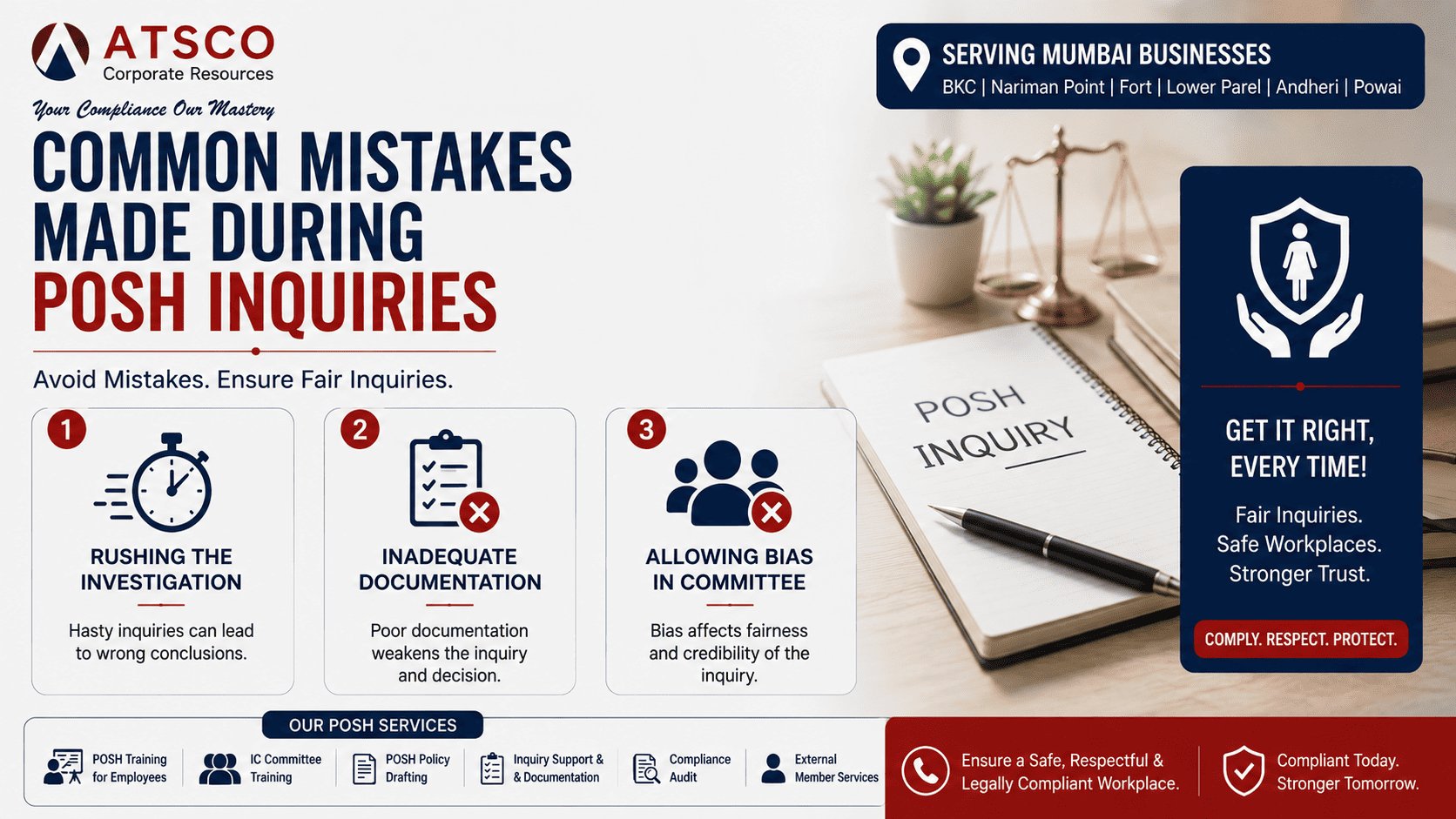
10 Common Mistakes in POSH Investigations
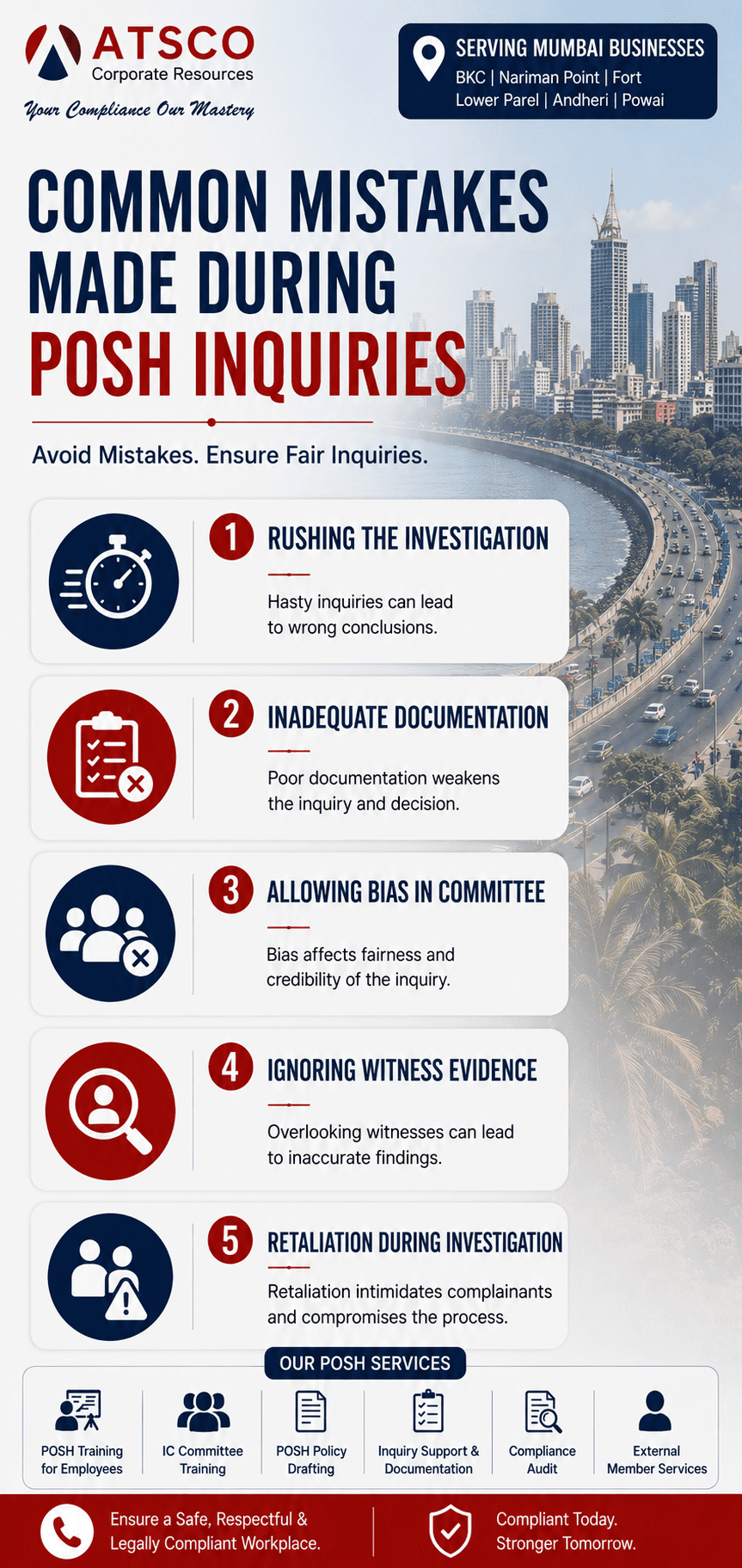
How Should IC Members Record Statements and Evidence? A Practical Guide for Fair POSH Investigations
Documentation is the backbone of any credible POSH investigation. While conducting fair interviews is critical, how you record what’s said determines whether your investigation can withstand legal scrutiny. Poor documentation undermines even thorough investigations, while meticulous recording ensures findings are defensible during inspections or legal challenges.
Many Internal Complaints Committee (ICC) members struggle with practical recording methods. Should you record audio? Take handwritten notes? Use digital transcripts? This guide provides practical standards for recording statements and preserving evidence that satisfy legal requirements while remaining practical for organizations across Mumbai.
Why Proper Documentation Matters
Legal Reality: Courts and labour inspectors evaluate investigations primarily through documentation. If your files don’t show fair process, detailed inquiry, and proper evidence analysis, findings become legally vulnerable regardless of actual investigation quality.
Real Scenario: A Ghatkopar IT company investigated harassment allegations. The investigation was actually fair and thorough, but documentation consisted of scattered notes with incomplete quotes. When accused challenged findings in court, lack of proper documentation weakened the organization’s position significantly, despite investigation being legitimate.
Lesson: Excellent investigation + poor documentation = vulnerable findings. Good documentation can support even moderately conducted investigations.
Google Reviews by Clients


It has experienced & dedecated staff round the clock to give you prompt service without any hurdles.
*Best services*


A All
T Together
S Support
C Councilling for PF, ESIC, Employee and Company
O Office of sorting out problem of all
Come and share your problems as your compliments our Mastery
Methods for Recording Statements
Advantages:
- Captures exact words and tone
- Prevents misquotation disputes
- Allows later transcription review
- Shows genuine responses without interpretation
Implementation:
- Inform participant beforehand: "We'll be recording this interview with your consent. This ensures accuracy of your statement."
- Obtain written consent: Have participant sign consent form before recording
- Use quality equipment: Professional audio recorder or smartphone recording app (test beforehand)
- Label recording clearly: "Recording_Complainant_Date_Time" format
- Store securely: Password-protected files, backed up, accessible only to ICC members
When Appropriate:
- Complex investigations requiring visual context
- Multiple simultaneous allegations
- Demonstrating demeanor and credibility assessment
- Serious allegations where comprehensive documentation is crucial
Implementation:
- Obtain explicit written consent: Video recording is more intrusive than audio
- Neutral setting: Professional, quiet room with adequate lighting
- Single camera angle: Focusing on interviewee (not ICC member)
- Professional conduct: Maintain serious, professional tone throughout
- Secure storage: Encrypted files with restricted access
When to Use:
- If participant refuses audio/video recording
- Quick statements or brief interactions
- Preliminary investigations before formal inquiry
- Supplementary documentation alongside audio
Standards for Written Notes:
- Taken during interview (not afterward from memory)
- Verbatim quotes where possible (use quotation marks)
- Paraphrasing clearly marked as such (not direct quotes)
- Dated, timed, and signed by note-taker
- Organized chronologically within interview
- Action items or follow-ups clearly noted
"Interview with [Name], [Date], [Time]. Participant stated: 'He made unwanted comments about my appearance on three occasions—June 15, June 22, and July 3.' When asked for specifics, complainant reported: [specific comments]. Participant appeared distressed during recounting. Witness mentioned as present: [Name]."
"Discussed harassment. She said things happened. Very upset."
The difference is clarity and usability during investigation analysis.
Best Practice for Serious Investigations:
- Audio Record: Primary documentation method
- Simultaneous Notes: ICC member takes notes of key points, timestamps important statements
- Written Summary: Post-interview, create written summary (while memory is fresh) capturing:
- Interview date, time, duration
- Participant name and role
- Key allegations or responses
- Relevant quotes (verbatim where noted in audio)
- Witness names mentioned
- Follow-up actions needed
- Transcription: For critical statements, transcribe audio portions verbatim
Time-Intensive: Yes, this approach requires more effort, but investment pays off when investigation is legally challenged.
Evidence Collection and Documentation
What to Collect:
- Emails between parties (especially harassment-related)
- Chat messages (WhatsApp, Slack, Teams, etc.)
- Performance reviews or appraisals
- Leave records (to verify availability during alleged incidents)
- Organizational hierarchy documents (to establish relationships)
- Any written complaints or grievances
- Incident reports or accident records
- Witness statements in writing
Documentation Process:
- Obtain originals where possible (not screenshots only)
- Verify authenticity: Confirm sender identity, date, context
- Preserve originals: Store safely, don't alter or annotate
- Create copies: Work from copies, preserve originals
- Index systematically: Create evidence index ("Email_June15_Accused_Complainant") for reference during analysis
- Note source: Document where evidence came from and when accessed
• Obtain email from organization's email system (not screenshot)
• Verify sender address, timestamp, recipient list
• Include full email chain for context
• File under "Email Evidence" with clear labeling
• Cross-reference in investigation notes ("See Email Evidence #3")
What to Collect (if applicable):
- Gifts or notes left by accused
- Photographs (if harassment involved photography)
- Physical items mentioned in complaint
- Workplace environment photographs (facilities, positioning)
Documentation Process:
- Photograph evidence: Take clear photos with date/time stamps
- Chain of custody: Document who handled evidence when
- Secure storage: Keep original items safely
- Detailed description: Write detailed description of physical evidence
Each Witness Interview Should Have:
- Full name and designation
- Relationship to complainant and accused
- Direct observations they witnessed (vs. hearsay)
- Dates and times of observations
- Any communication from complainant/accused about incident
- Consent to share information with other parties
- Contact information for follow-up
"Witness Statement - [Name], [Designation], [Date]. Witness reports direct observation: [specific statement]. Witness states did not witness: [clarifying what witness didn't see but may have heard]. Interview conducted by: [ICC member name]."
Confidentiality in Documentation
Physical Documentation:
- Locked cabinet or safe (not accessible to general staff)
- Only ICC members have keys
- Access log maintained (who accessed files when)
- Files organized systematically (not scattered)
Digital Documentation:
- Password-protected folders/files
- Encryption for sensitive materials
- Access restricted to ICC members only
- Backup copies stored securely (not accessible to IT team unless essential)
- No emails forwarding investigation details to unnecessary parties
Who Should Access Investigation Files:
- ICC members
- Employer (typically HR director or MD)
- External counsel (if legal review needed)
- Not: Accused until formal findings
- Not: Complainant's manager or colleagues
- Not: General HR staff
Maintain record of who accessed investigation files when:
"[Name], [Date], [Time], [Purpose]"
This demonstrates controlled access and prevents unauthorized circulation.
Legal Compliance Standards
Written Consent Must Include:
- Type of recording (audio/video)
- How recording will be used (investigation only)
- Who will access recording (ICC members only)
- Duration of storage (typically until investigation concludes + legal retention period)
- Voluntary consent acknowledgment (participant confirms they're willing)
"I agree to participate in this interview and consent to audio recording. I understand the recording will be used only for this investigation, accessed only by ICC members, and stored securely. I acknowledge this is voluntary."
If Transcribing Audio:
- Transcribe verbatim (every word)
- Clearly indicate pauses, emotional tone if significant ("stated with anger:" "answered hesitantly:")
- Identify speakers clearly
- Note inaudible portions ("inaudible section 3:45-3:52")
- Review for accuracy before filing
Retention Period:
- Keep investigation files minimum 7 years (as per labour law record retention)
- Extend retention if legal challenge or appeal is pending
- Maintain audio recordings for 3-5 years minimum
Destruction Protocol:
- When retention period ends, securely destroy files
- For digital files: use secure deletion software (not just delete)
- For physical files: shred or burn
- Document destruction with date and method
- Do not destroy if legal challenge pending
Common Documentation Mistakes
Mistake 1: Incomplete Notes
Poor Example: "Harassment happened. Very upset. Need to follow up."
Good Example: "Harassment occurred on June 15, 2024, at approximately 2:30 PM in the conference room. Alleged harasser made specific comment: [exact quote]. Complainant witnessed by [Name]. Complainant reported feeling humiliated and considering resignation."
Mistake 2: Prejudicial Language
Avoid: "Complainant is known to be oversensitive," "Accused is generally ethical despite this incident," "The woman overreacted."
Better: "Complainant reported feeling significantly distressed," "Accused denies intentional harassment," "Complainant's emotional response to incident was [describe objectively]."
Why Choose ATSCO Corporate Resources?
Experience and Expertise
With 18 years of experience, ATSCO Corporate Resources is a trusted labour law consultancy firm, serving 50+ corporates across diverse industries
Comprehensive Services
Providing end-to-end functions of payroll services, including time and attendance management and leave processing
Skilled Team
Emphasize the expertise of the team in handling complex payroll issues