
Menu
Can Men File Sexual Harassment Complaints at the Workplace?
Can a man file a complaint under the POSH Act in India? Can male employees complain about sexual harassment at the workplace? What should Mumbai companies do when a male employee faces sexual harassment?
These are increasingly important questions for employers, HR professionals and employees across Mumbai, Navi Mumbai and Thane.
The answer requires an important distinction: The POSH Act, 2013 is Not gender-neutral. The law was enacted specifically to protect women from sexual harassment at the workplace. However, organisations can adopt a separate gender-neutral workplace sexual harassment policy to provide a mechanism for employees who are not covered by the POSH Act, including male employees.
For companies operating in Mumbai’s corporate offices, manufacturing units, IT companies, start-ups, service organisations and other workplaces, understanding this distinction is important for effective POSH compliance and workplace harassment prevention.

Can Men File a Complaint Under the POSH Act?
No. A man cannot file a complaint as an “aggrieved woman” under the POSH Act.
The Sexual Harassment of Women at Workplace (Prevention, Prohibition and Redressal) Act, 2013 specifically provides protection to an “aggrieved woman.” Section 9 of the Act provides the mechanism for an aggrieved woman to make a complaint of sexual harassment to the Internal Committee or Local Committee.
Therefore, the POSH Internal Committee is a statutory mechanism established under the POSH Act for complaints covered by the Act. It would therefore be legally inaccurate for an organisation to describe the POSH Act itself as a gender-neutral sexual harassment law.
Does This Mean Men Have No Remedy Against Sexual Harassment?
No.
The fact that the POSH Act is not gender-neutral does not mean that an organisation should ignore a complaint of sexual harassment made by a male employee.
Employers can establish a gender-neutral workplace harassment policy that operates separately from the statutory POSH framework.
Such a policy can provide employees of all genders with a mechanism to report:
- Sexual harassment
- Sexually inappropriate behaviour
- Unwanted sexual comments or advances
- Sexually explicit messages or communications
- Unwanted physical contact
- Sexual jokes or remarks
- Other forms of sexually inappropriate workplace conduct
The organisation can then deal with such complaints under its internal disciplinary, grievance or workplace conduct framework.
POSH Act vs Gender-Neutral Workplace Harassment Policy
For organisations in Mumbai, it is useful to clearly distinguish between these two mechanisms.
| POSH Act | Gender-Neutral Workplace Policy |
|---|---|
| Statutory legislation | Internal organisational policy |
| Specifically protects women covered by the Act | Can provide protection to employees of all genders |
| Complaint made by an aggrieved woman | Can receive complaints from employees outside the POSH framework |
| Handled through the statutory Internal Committee / Local Committee mechanism as applicable | Can be handled through a separate disciplinary/grievance committee |
| Governed by the POSH Act | Governed by organisational policy, employment terms and applicable disciplinary rules |
| Statutory POSH inquiry procedure applies | Organisation's prescribed investigation and disciplinary procedure applies |
This distinction should be clearly explained in the organisation's POSH Policy, Employee Handbook, Code of Conduct and workplace grievance framework.
Should Mumbai Companies Create a Separate Committee for Male Sexual Harassment Complaints?
Organisations may establish a separate independent disciplinary or workplace grievance committee to address complaints that fall outside the POSH Act, including complaints of sexual harassment made by male employees.
However, this should be understood correctly:
The POSH Act does not itself mandate a separate committee for male complainants. Rather, the organisation can create such a mechanism through its internal policy and disciplinary framework.
The committee may be designated as a:
- Workplace Harassment Committee
- Gender-Neutral Grievance Committee
- Employee Grievance Committee
- Disciplinary Committee
- Workplace Conduct Committee
The organisation should clearly specify the committee's role, authority, investigation procedure and disciplinary powers.
Why Should Organisations Have a Gender-Neutral Sexual Harassment Policy?
Mumbai has a diverse workforce comprising employees working across corporate offices, factories, IT companies, start-ups, retail organisations, professional services firms and other establishments.
A workplace harassment policy that provides a reporting mechanism for employees of all genders can help organisations:
1 Provide a clear reporting mechanism
Employees should know where they can report inappropriate workplace conduct, even when their complaint does not fall within the statutory POSH framework.
2 Prevent gender stereotypes
Male employees may hesitate to report sexual harassment because of social perceptions that men cannot be victims of sexual harassment. A gender-neutral policy can address this gap.
3 Maintain a fair investigation process
Complaints should be assessed objectively, with both the complainant and respondent being given a fair opportunity to present their respective cases.
4 Protect confidentiality
Workplace harassment complaints should be handled confidentially and information should be shared only with persons who have a legitimate need to know.
5 Prevent retaliation
Employees who report workplace misconduct should not face retaliation, victimisation or adverse treatment for making a complaint in good faith.
Example: Male Employee Facing Sexual Harassment in a Mumbai Workplace
Consider a hypothetical situation.
A male employee working in a corporate office in BKC, Andheri, Lower Parel or Powai alleges that a colleague repeatedly sends sexually explicit messages, makes unwanted sexual comments and engages in unwanted physical contact.
The employee cannot approach the POSH Internal Committee as an “aggrieved woman” under the POSH Act.
However, if the organisation has a gender-neutral workplace harassment policy, he can submit his complaint through the mechanism prescribed under that policy.
The designated disciplinary or grievance committee can examine the complaint, review relevant evidence, hear both parties and arrive at appropriate findings under the organisation's applicable policy and disciplinary framework. If the allegations of misconduct are established, the organisation can take appropriate disciplinary action in accordance with its applicable rules and policies.
What Should the Organisation's Policy Include?
A well-drafted gender-neutral workplace harassment policy should clearly address:
- Who can make a complaint
- What constitutes sexual harassment and inappropriate sexual conduct
- Who will receive the complaint
- Time limits, if any
- Investigation procedure
- Constitution and role of the committee
- Confidentiality
- Protection against retaliation
- Rights of the complainant
- Rights of the respondent
- Principles of natural justice
- Documentation and evidence
- Disciplinary consequences
- Appeal or review mechanism
The policy should also clearly state that the gender-neutral mechanism is separate from the statutory POSH mechanism.
What About False or Malicious POSH Complaints?
Organisations should also be careful when dealing with allegations of false or malicious complaints.
- A complaint should not automatically be treated as false merely because it cannot be proved.
- Similarly, an employee should not be presumed guilty merely because a complaint has been made.
- The organisation should conduct a fair and impartial process before arriving at findings.
Where a complaint is established to have been deliberately false or malicious, appropriate action may be considered in accordance with the applicable law, service rules and organisational disciplinary policy.
This distinction is particularly important because “unsubstantiated” does not automatically mean “false.”
What Should HR Teams and Employers in Mumbai Do?
Companies in Mumbai, Navi Mumbai and Thane should consider reviewing their existing workplace policies to ensure that there is clarity between:
POSH Compliance (For complaints covered by the POSH Act):
Aggrieved Woman
→
Internal Committee
→
POSH Act procedure
Gender-Neutral Workplace Harassment Mechanism (For complaints outside POSH framework):
Employee
→
Gender-Neutral Mechanism
→
Disciplinary/Grievance Committee
→
Internal disciplinary procedure
This approach allows an organisation to maintain compliance with the POSH Act while also establishing a broader workplace framework for addressing sexual harassment and inappropriate conduct involving employees of all genders.
Key Takeaway for Mumbai Employers
The important point is simple:
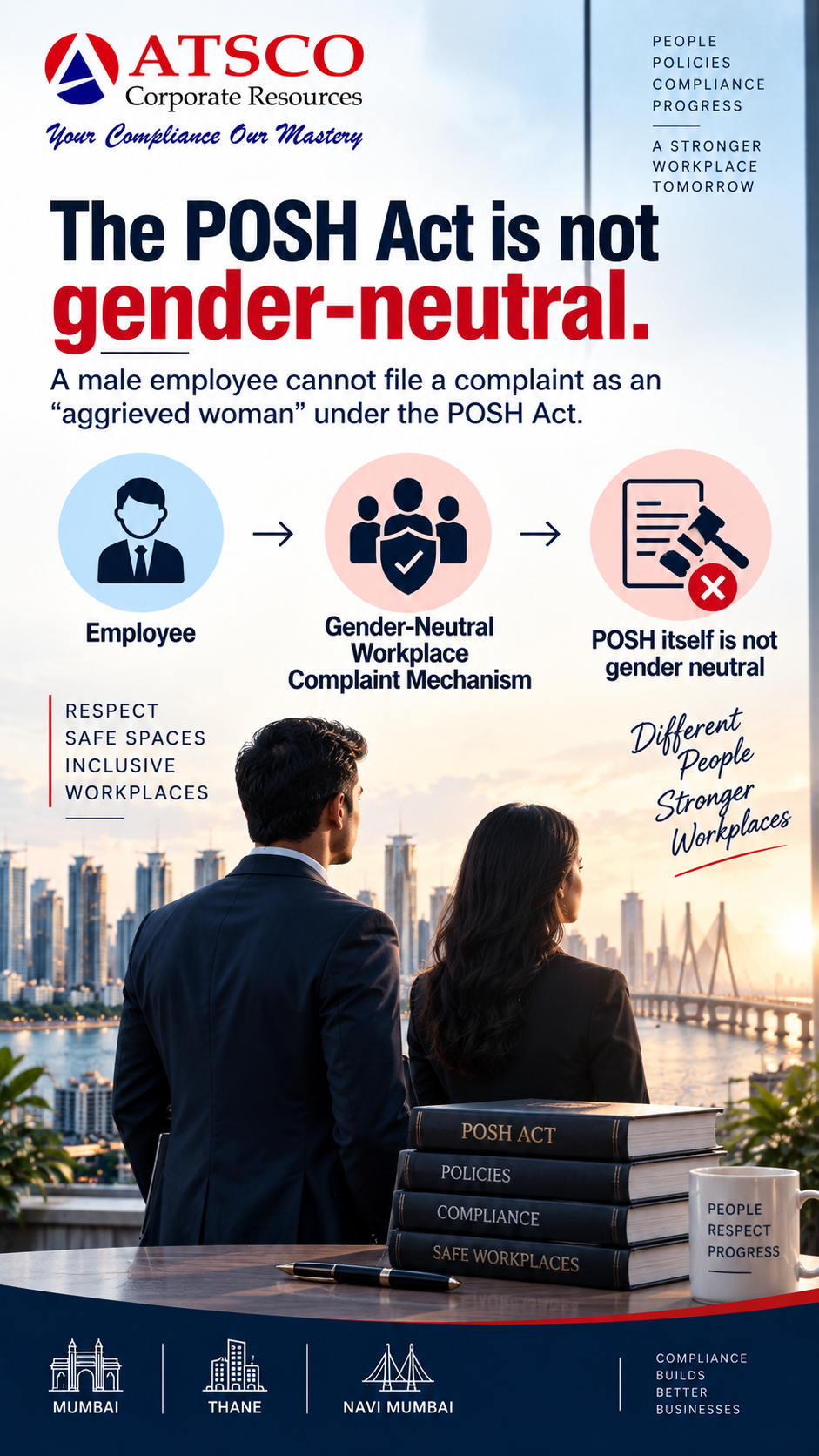
The POSH Act is not gender-neutral. A male employee cannot file a complaint as an “aggrieved woman” under the POSH Act.
However, organisations can adopt a separate gender-neutral workplace harassment policy to address complaints of sexual harassment made by male employees and other employees who are outside the statutory scope of the POSH Act.
A separate disciplinary or grievance committee can be designated under the organisation's internal policy to investigate such complaints.
For employers in Mumbai, Navi Mumbai and Thane, having both mechanisms clearly documented can help create a workplace where complaints are addressed through the appropriate legal and organisational process.
Looking for POSH Compliance Support in Mumbai?
Organisations looking for POSH compliance, POSH policy drafting, Internal Committee training, Employee Awareness Sessions and workplace harassment policy support in Mumbai should ensure that their policies accurately distinguish between statutory POSH compliance and broader gender-neutral workplace conduct requirements.
A properly structured framework can help HR teams and employers understand:
- What falls under POSH?
- What falls outside POSH?
- Who should investigate the complaint?
- What policy should apply?
- What disciplinary mechanism should be followed?
The objective is to ensure that every workplace complaint is addressed through the correct legal and organisational mechanism, while maintaining fairness, confidentiality and due process.
POSH Compliance
POSH Training
Internal Committee Training
Workplace Harassment Policy
Mumbai
Navi Mumbai
Thane
Google Reviews by Clients

Dhawal Gadda
2 years ago
I highly recommend ATSCO for anyone looking for reliable, knowledgeable, and dedicated labour law services.

keshav korgaonkar
2 years ago
ATSCO is a professionally managed consultacy firm believe in employee's upgradation in their skill and knowledge.

Manjeet Bilthare
2 years ago
Good services especially for Labour Law Compliance. I will highly recommend ATSCO to others.

Sandip Jangle
2 years ago
ATSCO is genuine Company which had mastered & deals in day to day activity of Company's Legal compliance (Labour Laws)
It has experienced & dedecated staff round the clock to give you prompt service without any hurdles.
*Best services*

Rohan Margaj
2 years ago
Professionals,5 ⭐⭐⭐⭐⭐ for all the staff . Great co-ordination and support for any query related compliance and labour law, Customer gets the worth for the money he is spending to avail consultancy services..

Purav Shah
2 years ago
ATSCO
A All
T Together
S Support
C Councilling for PF, ESIC, Employee and Company
O Office of sorting out problem of all
Come and share your problems as your compliments our Mastery
Get Expert POSH Training and Compliance Support from ATSCO Corporate Resources
Organisations looking for POSH compliance, POSH policy drafting, Internal Committee training, Employee Awareness Sessions and workplace harassment policy support in Mumbai should ensure that their policies accurately distinguish between statutory POSH compliance and broader gender-neutral workplace conduct requirements.
Why Choose ATSCO Corporate Resources?
Experience and Expertise
With 18 years of experience, ATSCO Corporate Resources is a trusted labour law consultancy firm, serving 50+ corporates across diverse industries
Comprehensive Services
Providing end-to-end functions of payroll services, including time and attendance management and leave processing
Skilled Team
Emphasize the expertise of the team in handling complex payroll issues
Get Expert POSH Complaint Guidance from ATSCO Corporate Resources
Contact ATSCO Corporate Resources today for expert POSH Act Law Training Mumbai, POSH investigation support that protects complainants, ensures fair process for accused, and safeguards your organization legally.