
Common Labour Law Violations By Contractors
When your business engages contractors, you’re not just hiring their services—you’re also accepting significant legal responsibility for their labour compliance. Many Mumbai principals, from BKC offices to MIDC Andheri factories, mistakenly believe that contractor compliance is entirely the contractor’s problem. This misconception has landed countless businesses in legal trouble, hefty penalties, and operational disruptions.
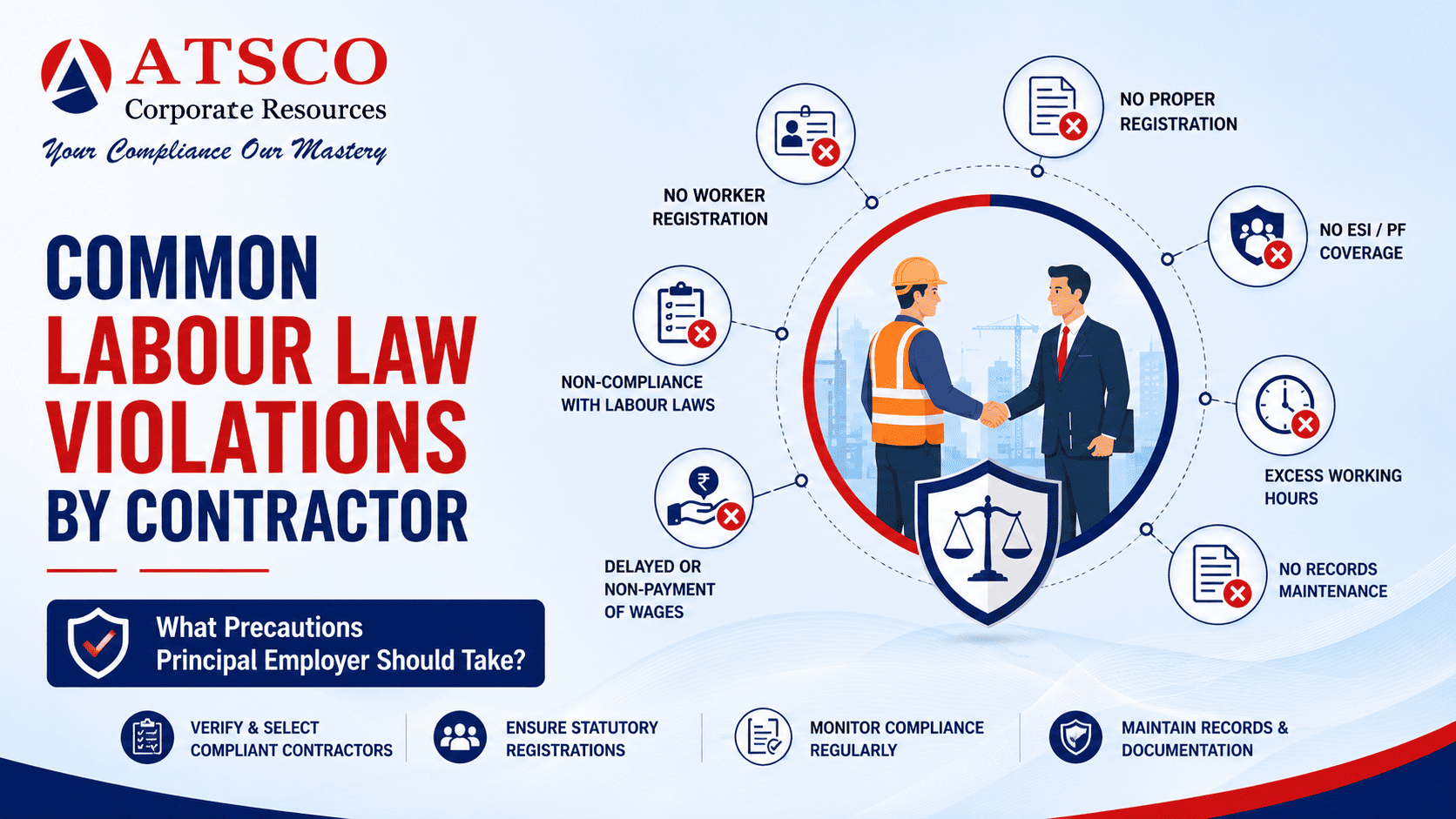
Understanding Principal Employer Liability
Under the new Labour Code 2025, principal employer responsibilities extend far beyond just paying the contractor’s invoice. The law recognizes that contractors often cut corners on labour compliance to reduce costs, so it holds you—the principal employer—jointly liable for violations occurring at your premises.
Most Common Labour Law Violations By Contractors
- Missing or Invalid Contractor License
Contractors operating without proper registration and licensing is rampant across Mumbai—from Worli service providers to Bhiwandi industrial units.
The Violation: The Occupational Safety, Health and Working Conditions Code mandates contractor licensing. Many contractors operate with expired licenses or no licenses at all.
Your Liability: Engaging an unlicensed contractor makes you liable for ₹50,000 fine + imprisonment potential for responsible officers.
Prevention: Before engaging any contractor, verify their license validity. Request copies and keep them on file. For Thane-based operations, check with the local labour commissioner’s office.
- Non-Enrollment in PF and ESI
This is the most widespread contractor labour compliance issue affecting businesses in Powai IT parks, Dadar offices, and Andheri MIDC equally.
The Violation: Contractors often don’t enroll their workers in Provident Fund (PF) or Employee State Insurance (ESI), violating the Code on Social Security 2020.
Worker Impact: Workers denied medical benefits, disability coverage, and retirement savings—fundamentally unfair treatment.
Principal Employer Consequences: You face:
- Back-payment of all PF contributions (12% employee + 12% employer)
- Back-payment of ESI (0.75% + 3.25%)
- 12% annual damages on delayed contributions
- Criminal prosecution penalties
Example: A Vashi-based logistics company discovered their contractor hadn’t enrolled 35 workers in ESI for 18 months. Back-contributions alone exceeded ₹4.2 lakhs, plus penalties reached ₹1.8 lakhs.
- Inadequate Wage Payment and Documentation
Contractors frequently pay workers cash without proper wage slips, making wage verification impossible during inspections.
Common Issues:
- No written wage slips
- Wages paid below minimum rates
- Unauthorized deductions (rent, uniforms) without proper agreements
- Delayed wage payments beyond the 7th of following month
Principal Employer Problem: You’re held responsible for ensuring workers receive statutory minimum wages. If inspection reveals wage violations, you face penalties and potential back-wage liability.
- Unsafe Working Conditions and Missing Safety Equipment
Labour compliance issues in contractor management often involve inadequate safety measures—particularly critical in manufacturing and construction sectors.
In Turbhe manufacturing areas: Contractors sometimes employ workers without providing basic safety gear to reduce costs, creating accident risks and legal liability for principal employers.
- Contractor Documentation Mistakes
Many contractor compliance in Navi Mumbai and CBD Belapur fails due to poor documentation—ironically, the easiest to fix but most frequently overlooked.
Missing Documentation:
- No written contractor agreement
- No worker appointment letters
- Missing attendance registers
- No wage registers
- Incomplete employee records (Aadhaar, family details)
- No PF Form 11 or ESI enrollments
- Accident records missing (if applicable)
Inspection Problem: Inspectors treat missing documentation as violations even if actual compliance existed. A Kalyan contractor couldn’t prove he had enrolled workers properly because records were lost—resulting in penalties despite actual compliance.
- Contractor Employing Unregistered Sub-Contractors
Complex contractor structures in construction and large manufacturing projects often involve multiple layers. Each layer must be properly registered and compliant.
Issue: A principal employer in Dombivli engaged a contractor who then sub-contracted to another unregistered contractor. The principal employer was held liable for the sub-contractor’s violations—a violation they had no direct knowledge of.
The Lesson: Principal employer responsibilities include verifying not just direct contractors but their sub-contracting arrangements too.
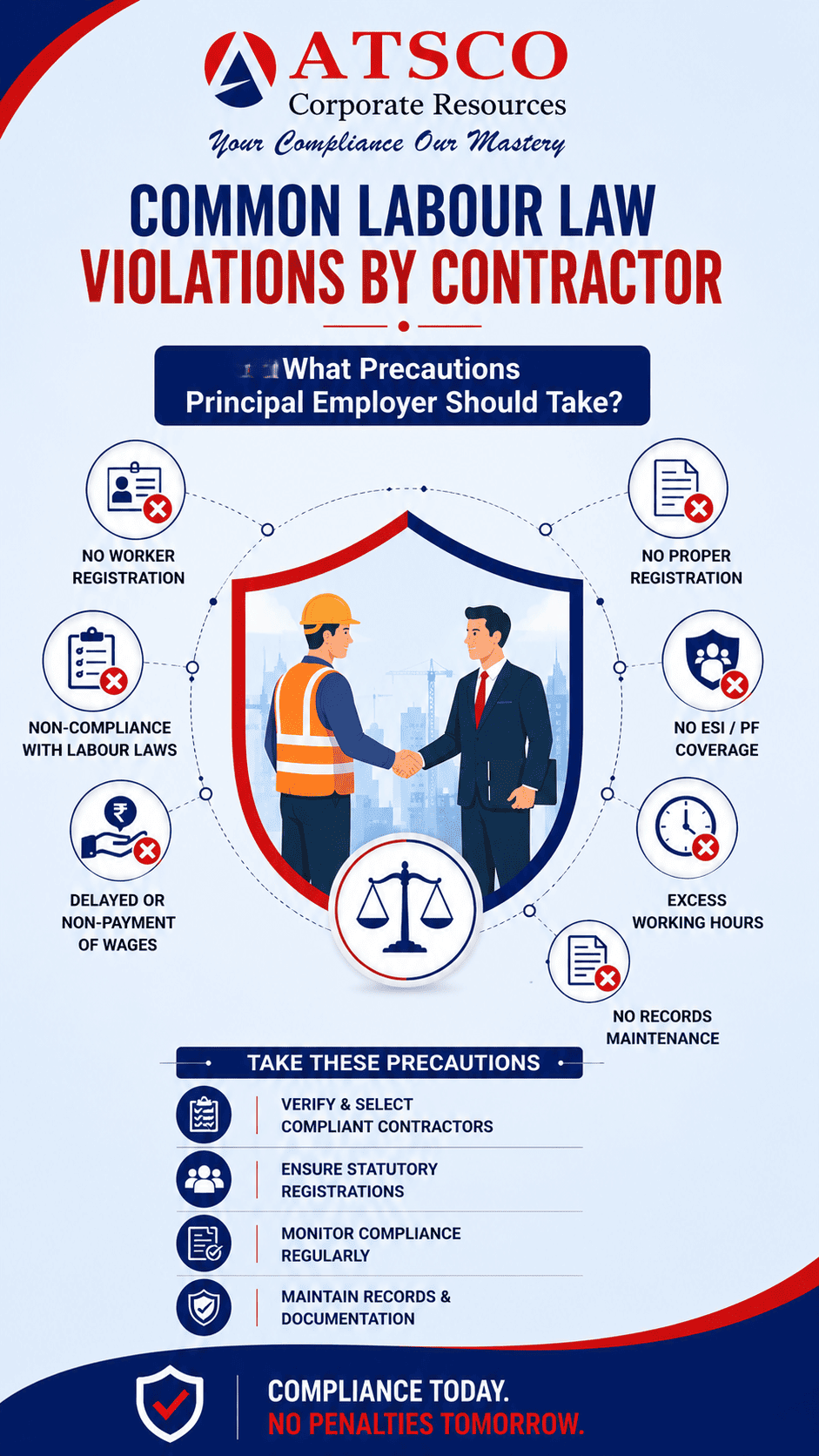
Contractor Compliance Checklist: What You Must Verify
Before engaging any contractor and periodically thereafter, ensure:
Licensing & Registration:
- Valid contractor license (not expired)
- PF registration certificate
- ESI registration certificate
- Professional Tax registration (if applicable)
- Shop & Establishment registration
- Insurance policy (if required)
Contractual Documentation:
- Written contract defining responsibilities
- Clear wage payment terms
- Statutory compliance obligations
- Safety responsibility definitions
- Indemnity clauses for non-compliance
- Termination clauses for compliance violations
Worker Documentation:
- Appointment letters for all workers
- Attendance registers
- Wage registers with individual worker details
- PF enrollment proof (Form 11)
- ESI enrollment proof
- Safety equipment issue records
- Accident registers (if applicable)
Operational Compliance:
- Minimum wage compliance verification
- Working hours within legal limits
- Safety equipment provided to all workers
- No unauthorized deductions from wages
- Timely wage payments (before 7th of next month)
Google Reviews by Clients


It has experienced & dedecated staff round the clock to give you prompt service without any hurdles.
*Best services*


A All
T Together
S Support
C Councilling for PF, ESIC, Employee and Company
O Office of sorting out problem of all
Come and share your problems as your compliments our Mastery
Principal Employer Responsibilities: Your Legal Obligations
Understanding your specific obligations helps you manage contractor compliance effectively.
- Verification Before Engagement
Before hiring any contractor, you must verify their compliance history, licensing status, and financial stability. A quick check could prevent costly future liabilities.
For Worli-based businesses: Labour department websites list registered contractors. Cross-check your proposed contractor’s credentials.
- Written Agreement Clarity
A properly drafted contractor agreement should clearly specify:
- Who pays workers (contractor or you)
- Who bears statutory obligations (usually shared)
- What happens if contractor violates compliance
- Your right to audit compliance
- Termination rights for violations
Critical Point: Vague agreements later become sources of disputes. Courts don’t favour principal employers who claim ignorance of contractor practices.
- Periodic Compliance Audits
Principal employer responsibilities include regular verification that contractors maintain compliance.
Recommended Schedule:
- Monthly: Wage slip and attendance verification
- Quarterly: Comprehensive compliance audit
- Annual: Documentation review and record-keeping check
In Neral: Progressive manufacturers conduct monthly contractor compliance audits, checking wage records, safety equipment, and worker interviews.
- Maintaining Your Own Records
Keep copies of contractor licenses, agreements, employee rosters, and compliance verifications. These documents prove you exercised due diligence if inspections occur.
Document Retention: Maintain records for minimum 7 years (as per labour laws).
- Immediate Action on Violations
When you discover contractor compliance issues, immediate remediation is critical. Delays suggest negligence and increase penalties.
If you discover contractor violations:
- Stop engaging that contractor immediately
- Direct workers to cease work
- Ensure back-payments are made
- Correct documentation gaps
- Report to relevant authorities (if required)
- Document all remediation steps
- Worker Grievance Mechanism
Establish channels for workers to report compliance violations—to you directly if they distrust the contractor.
A Powai IT company implemented a confidential hotline for contractor-supplied workers to report wage delays, safety issues, or wage violations. This enabled quick identification and resolution of problems before inspection.
Common Contractor Management Issues Affecting Compliance
Issue 1: Multiple Contractors Without Centralised Oversight
Large establishments with 5-10 different contractors often lack centralised compliance management. Each contractor operates independently, creating compliance gaps.
Solution: Assign a compliance officer to oversee all contractors, maintain consolidated records, and conduct regular audits.
Issue 2: Cost-Cutting Pressures Leading to Compliance Corners
Contractors often accept projects at rates requiring compliance corners—lower wages, no safety equipment, no statutory coverage—to remain profitable.
Solution: Ensure contractor contracts include adequate margins for compliance. Don’t negotiate rates so low that compliance becomes impossible.
Issue 3: Seasonal or Temporary Contractors Ignored
Seasonal workers in Lower Parel or temporary construction workers in CBD Belapur are often treated as exempt from compliance requirements. They’re not.
Reality: Temporary and seasonal workers have identical compliance rights as permanent workers. Every hour worked entitles them to minimum wages, safety provisions, and statutory coverage (if threshold is met).
Issue 4: Contractor Wage Misrepresentation
Contractors sometimes report lower wages to EPFO/ESIC than actually paid—reducing statutory contributions while workers remain unaware.
Risk: This false documentation creates audit liabilities for principal employers who unknowingly report incorrect data.
Labour Inspection Preparation - Contractor-Related Questions You'll Face
When labour inspectors arrive—whether in Bhiwandi industrial areas or Mahape business parks—expect these contractor-focused questions:
Documentation Questions:
- “Where is the contractor license? When does it expire?”
- “Show me the written contractor agreement.”
- “Where are the worker appointment letters?”
- “What documentation do you maintain for contractor verification?”
Compliance Questions:
- “How do you verify contractor compliance with PF/ESI?”
- “Who is responsible for worker safety equipment?”
- “How often do you audit contractor compliance?”
- “What action did you take when you discovered violations?”
Worker Questions:
- “Are these workers aware of their statutory benefits?”
- “Has anyone reported wage or safety issues?”
- “How are complaints handled if workers report violations?”
Preparation: Maintain a contractor compliance file with licenses, agreements, audit reports, worker rosters, and evidence of periodic verification.
Labour Law Penalties for Principal Employers
Understanding potential penalties emphasizes why contractor compliance matters:
Financial Penalties:
- Engaging unlicensed contractors: Up to ₹50,000
- PF/ESI non-coverage: Up to ₹6,500 per worker + back-contributions
- Safety violations: Up to ₹2,00,000
- Working condition violations: Up to ₹50,000
- Repeated violations: Double penalties
Criminal Liability:
- Responsible officers face imprisonment (3 months to 1 year)
- Personal liability for company violations
- Criminal records affecting future business
Operational Consequences:
- Labour inspectors can stop operations until compliance is achieved
- Significant disruptions to business
- Reputational damage affecting clients and recruitment
Real Impact: A Kalyan-based contractor management failure resulted in ₹28 lakh penalties, 6-month operational disruption, and permanent reputation damage affecting the company’s ability to secure government contracts for 3 years.
How to Avoid Labour Law Violations - Practical Steps
Step 1: Contractor Pre-Engagement Verification
Before engagement, verify:
- Current license validity
- PF and ESI registration
- Previous compliance record
- Financial stability
- Insurance coverage (if applicable)
For Thane businesses: Contact the Thane Labour Commissioner’s office to verify contractor credentials.
Step 2: Comprehensive Written Agreements
Draft detailed contractor agreements specifying:
- Scope of work and duration
- Wage payment responsibility (who pays whom)
- Statutory compliance obligations (shared responsibility)
- Safety standards and equipment provision
- Documentation maintenance requirements
- Audit rights for principal employer
- Remediation procedures for violations
- Termination for non-compliance
Step 3: Monthly Compliance Monitoring
Establish monthly monitoring including:
- Wage slip verification (actual payments match records)
- Attendance register review
- Safety equipment issue records
- Injury/accident reports
- Worker interviews (confidential if possible)
Step 4: Quarterly Comprehensive Audits
Conduct detailed quarterly reviews:
- PF and ESI payment verification
- Worker enrollment confirmation
- Documentation completeness check
- Compliance gap identification
- Remediation planning
Step 5: Immediate Issue Resolution
When violations are discovered:
- Address immediately, don’t delay
- Document the violation and remediation
- Ensure back-payments and corrections
- Follow-up verification
Step 6: Professional Compliance Management
For businesses in complex areas (Worli offices, MIDC Andheri factories), professional contractor compliance management through labour law consultants like ATSCO Corporate Resources ensures systematic oversight and reduces risk.
Industry-Specific Contractor Compliance Challenges
Manufacturing (Andheri MIDC, Bhiwandi): Safety violations are most critical. Workers operating machinery without proper training or PPE create accident risks and liability.
Construction (CBD Belapur, Turbhe Projects): Sub-contractor chains create complexity. Verifying compliance across multiple layers is challenging but essential.
IT Services (Powai, BKC): Contractor-supplied support staff (housekeeping, security, cafeteria) are often overlooked for compliance. They have identical rights as direct employees.
Logistics (Navi Mumbai, Vashi): High worker turnover makes enrollment and documentation challenging. Systematic processes are critical.
Conclusion - Principal Employer Responsibilities are Non-Negotiable
The legal framework is clear: principal employer responsibilities for contractor compliance are not optional. You cannot escape liability by claiming contractor autonomy. The law recognizes that contractors, driven by cost pressures, often violate compliance—so it holds you equally liable.
Whether you operate in BKC offices, Lower Parel warehouses, Andheri manufacturing units, or Thane logistics centers, robust contractor compliance management is essential. The cost of proactive compliance—through verification, audits, and documentation—is minimal compared to penalty costs when violations are discovered.
Smart businesses treat contractor compliance as a core operational responsibility, not an afterthought. Those who do enjoy penalty-free operations, reduced inspection stress, and reputation as ethical employers. Those who don’t face penalties, disruptions, and legal consequences that could have been entirely preventable.
Navigating principal employer responsibilities and contractor compliance issues requires expertise. ATSCO Corporate Resources specializes in comprehensive contractor compliance management across Mumbai, Navi Mumbai, and Thane regions.
Our Services Include:
• Contractor verification and licensing audits
• Compliance agreement drafting
• Monthly and quarterly compliance monitoring
• Audit and inspection preparation
• Violation remediation support
• Documentation management
Why Choose ATSCO Corporate Resources?
Experience and Expertise
With 18 years of experience, ATSCO Corporate Resources is a trusted labour law consultancy firm, serving 50+ corporates across diverse industries
Comprehensive Services
Providing end-to-end functions of payroll services, including time and attendance management and leave processing
Skilled Team
Emphasize the expertise of the team in handling complex payroll issues